
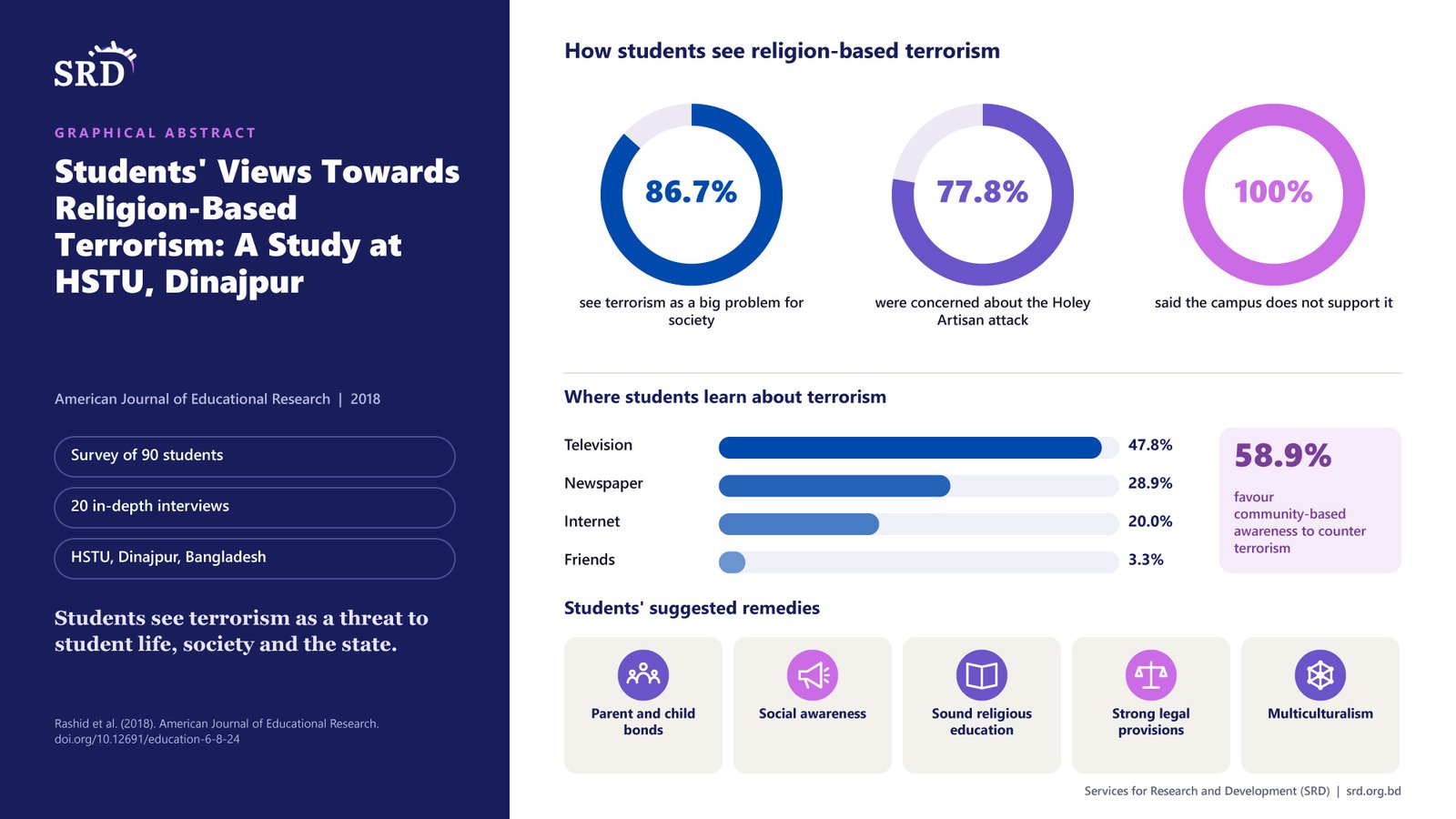
After a series of attacks in Bangladesh, including the Holey Artisan attack in 2016, investigations pointed to the involvement of some university students. That raised an urgent sociological question: how do students themselves understand religion-based terrorism? This study by Md Abdur Rashid and colleagues, including Md. Noman Amin, asked students at Hajee Mohammad Danesh Science and Technology University (HSTU), Dinajpur.
Why This Study Matters
Understanding students’ views helps universities, families and policymakers design prevention that speaks to young people rather than about them.
How The Study Was Done
The researchers surveyed 90 students from different departments and interviewed 20 students selected purposively.
Key Findings
- Strong rejection: 86.7% of students described terrorism as a big problem for society.
- Concern is real: 77.8% were extremely or slightly concerned about the Holey Artisan attack.
- Media is the main source: students learned about terrorism mostly from television (47.8%), newspapers (28.9%) and the internet (20%).
- Campus is not the cause: all respondents said the HSTU environment did not support religion-based terrorism.
What It Means
Students proposed their own remedies: stronger bonds between parents and children, social awareness, sound religious education, firm legal provisions and a stronger culture of multiculturalism.